
Does Composting Contribute to Climate Change?
Is composting good or bad for the planet?

There is concern that composting produces carbon dioxide, and excess CO2 adds to global warming. Does this mean that composting is contributing to climate change? Is this a practice that should be stopped in an effort to control rising temperatures?
It is a real dilemma for gardeners, and especially organic gardeners. Just when you thought you were doing something good for the planet, you find out that you may be causing harm.
Does Composting Produce Carbon Dioxide CO2?
Yes — but that does not mean it is a bad choice for the environment.
Does Composting Contribute to Climate Change?
The answer to this question is far more complex and really depends on how you ask the question.
In simple terms, a compost pile will produce CO2, which increases the CO2 in the air, which in turn results in the warming of our planet.
But that only looks at a specific part of the whole picture. Humans produce organic waste to feed ourselves. We grow corn and only eat the kernels. The rest of the plant is organic waste, and in fact, even a good part of the kernel exits our body as waste.
Another significant source of organic matter is edible food that is discarded. That half-eaten apple ends up as food waste that we affectionately call kitchen scraps. Roughly 1/3 of the food produced globally is wasted. Reducing this has a much bigger impact on climate change than anything you do about composting.
Assuming we don’t get rid of humans, we have to accept the fact that we create organic waste, and that waste decomposes at some point, producing CO2. We can’t prevent decomposition from happening. Therefore, it is important to reword the original question. What is the best way to handle organic waste?

The Carbon Cycle
Organic waste contains carbon, which originally came from the air. Plants use CO2 from the air to make all of the chemicals they need to grow. As plants grow, they reduce the CO2 in the air.
Composting is simply returning some of this absorbed carbon to the air. It is not adding additional amounts.
About 50% of the carbon in the original waste material is released as CO2 or CH4 during composting. The remaining 50% is added back to the soil. This form of carbon is commonly called humus, but in a previous post, I explained that humus does not really exist. However, the carbon in soil does exist.
The process of growing plant material, composting it, and returning it to the soil results in a net decrease of CO2 in the air and an increase in soil organic matter.
Recent studies show that backyards can be significant contributors to storing carbon in soil.
The Decomposition Process
Organic matter contains a lot of carbon, hydrogen, and oxygen, along with other minor molecules. This all becomes a food source for microbes that convert the large molecules into smaller and smaller molecules. This conversion requires energy, and in the process of extracting that energy, the microbes produce CO2. This is the same process that takes place when humans breathe out CO2.
The amount of CO2 produced depends very much on the method of decomposition. In general, a higher supply of oxygen results in more CO2 being produced.
Other greenhouse gases are also produced during decomposition, including methane and nitrous oxide.
Global Warming Potentials
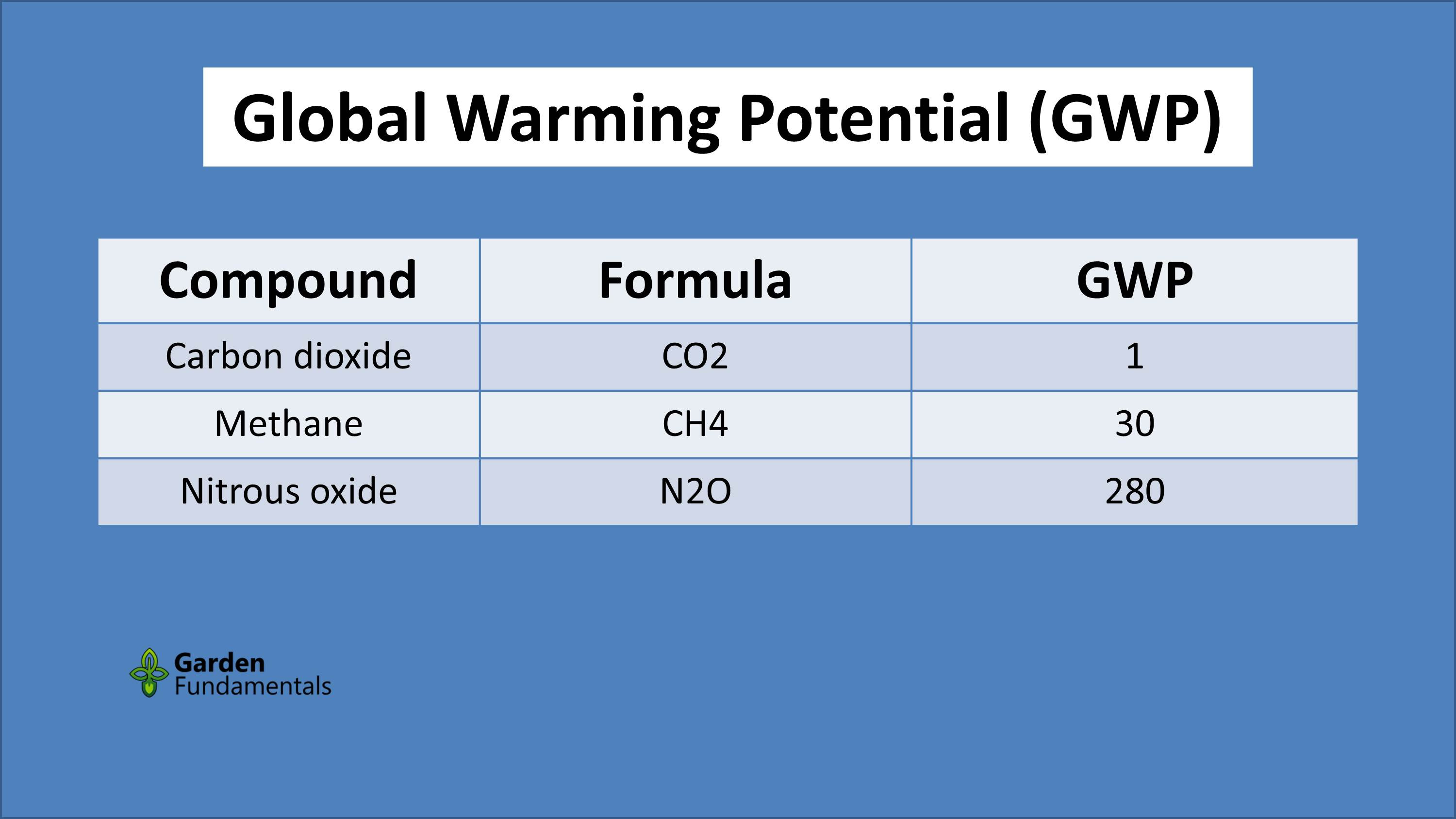
To understand this topic, it is critical to understand something called global warming potential (GWP). GWP is a measure of how much heat a gas absorbs. Carbon dioxide is used as the standard and has a relative value of 1.
Methane (CH4) has a value of about 30. This means that a molecule of methane contributes 30 times more heat to the air than a molecule of CO2. Or in simple terms, from a global warming perspective, methane is 30 times worse than CO2.
Nitrous Oxide (N2O), commonly called laughing gas, has a GWP of 280. It is 10 times worse than methane, and 300 times worse than carbon dioxide.
Why are these numbers important?
A molecule of carbon in organic waste can be converted to either CH4 or CO2, but not both. Since composting has to happen in some way, it is best for climate change if it happens in such a way that we reduce the production of nitrous oxide and methane, and produce CO2 instead.
As a general rule, aerobic conditions produce CO2, and anaerobic conditions produce methane and nitrous oxide.
Organic Matter in Landfill Sites
Since composting contributes to climate change, maybe there is a better way?
For homeowners, there are really only two options: put the material in the garbage, which ends up in landfill sites, or compost it. Putting it in the green bin for municipal composting is just another form of composting.
When organic matter is added to a landfill site, it gets mixed with all other types of garbage in very large piles. These piles exclude oxygen, resulting in composting that produces a lot of methane.
Some landfill sites collect the methane and recycle it into energy. Only 650 sites of the current 2,000 US sites do this and the process is only 60 to 90% efficient.
20 percent of total US methane emissions come from landfills.
Virtually any composting is better than sending the material to a landfill site because methane is 30 times worse than carbon dioxide.
Composting Options
We can’t stop producing organic matter, so the best option is to compost it in the most eco-friendly way. In this section, I’ll look at some options to see which is best for reducing climate warming.
Municipal Composting
The effect of this process on the environment depends very much on how it is done.
Anaerobic digestion carries out the decomposition in large digesters without oxygen and results in the production of methane. In some cases, this methane is captured and recycled. In Toronto, Ontario, for example, some of these biogases (mostly CH4 and CO2) are used to heat the facility and the digesters, but some of it is just burned off, producing CO2.
Other facilities use aerobic composting, which produces very little methane but does produce CO2.
This seems like a good alternative, but you have to consider the production of greenhouse gases to transport your waste to the facility, run the facility, and then transport the compost to its final destination.
If and when municipalities recapture all of the biogas and use it efficiently, anaerobic digesters might be a better alternative to home composting, as far as the production of greenhouse gases goes.
Standard Hot Composting
Standard backyard hot composting uses a traditional bin that creates an aerobic condition (with oxygen). These systems produce little or no methane but do produce CO2. Procedures that make hot compost keep the effect on climate change to a minimum: 3 x 3 ft size, chop organic matter into small pieces, use the right C/N ratio, keep it moist but not wet, and turn it regularly.
If the compost pile gets too wet or if not enough air gets to the middle of the pile, it will start producing more methane. This study found that with enough air flow, no detectable methane was produced. Other studies did find some methane, but the amounts are normally small.
Nitrous oxide is also produced during composting (see discussion below).
Some research has been done to determine the best hot composting method; there are so many variables, and very limited testing has been done so far.
Cold Composting
The reality is that most gardeners do not get their compost piles hot enough to consider the process hot composting. It is really lukewarm composting. Others just pile up fall leaves and let them compost slowly.
It is not clear how this impacts climate change, but you can expect that most of these processes occur less aerobically than hot composting, which means they produce more methane. From an environmental point of view, this type of home composting is less desirable than hot composting.
Direct Composting
There are two other approaches to composting: spreading organic matter over the ground so nature can do its thing, or burying the kitchen scraps underground.
Dropping organic matter as thin layers on top of the soil, what I like to call the cut and drop method, will produce very little methane because decomposition is very aerobic.
Burying the organic matter can be a problem. If it is buried too deep, it starts decomposing anaerobically, producing methane. The amount produced depends on the soil type. Coarse soil with good oxygen levels is less of a problem, but heavy clay soil with low oxygen is a problem. Keeping the organic matter closer to the surface will help keep it more aerobic.
The Elephant in the Room: Nitrous Oxide
Since nitrous oxide is so much worse for the environment than CO2, you would expect that this gets more attention, but that is not what I found. Few even mention it. I think in part this is because it is a more recent concern.
Nitrous oxide production is low during the hot composting process, but it may become higher during the curing process (once the pile cools down). It may also be high once applied to soil.
In 2006, the Intergovernmental Panel on Climate Change (IPCC) suggested that N2O emissions during the composting process are 3% of the nitrogen in the waste, but this is based mostly on manure systems, not yard waste. Recent reports suggest the number might be significantly lower than this, in which case, the production from composting is not a major factor for climate change.
Compost piles tend to generate most of the nitrous oxide at the end of the process. Keeping nitrogen levels down may help keep emissions low. Adding manure, which is generally higher in nitrogen, increases the production of nitrous oxide. Aeration keeps levels lower. This study found relatively low amounts of nitrous oxide produced in compost piles.
Does Composting Contribute to Climate Change?
Composting does produce CO2. However, when done properly, the complete cycle of growing plants followed by composting results in a net reduction of CO2 in the air and an increase in sequestered carbon in soil.
The composting process must produce as little methane and nitrous oxide as possible.
We can’t stop producing organic matter, and so our goal is to find the best way to return its carbon to the soil. Traditional hot composting is the best choice for most gardeners.
If you live near an anaerobic composting facility that completely recycles the produced biogases, it might be an eco-friendly option. Ideally, this facility returns compost to your garden once a year so that you can increase the carbon in your soil. But I suspect these facilities will never be as eco-friendly as backyard composting.