
Microplastic Solutions: Genetically Modified Organisms (GMOs)
Can the bugs around us get rid of microplastics?

Microplastics are everywhere: air, water, soil, and inside your body. Scientists are starting to discover ways of getting rid of them using genetically modified microbes.
What Are Microplastics?
Plastics are everywhere, and almost all of them slowly break apart into smaller and smaller bits of plastic. Large pieces are called garbage, but it breaks down into pieces so small our eyes can’t see them, we call them microplastics.
Microplastics are less than 0.2 inches (5 mm) in diameter. These pieces continue to break down even further until they become nonplastics. This process continues until they are fully gone, which can take many thousands of years.
Scientists have found these particles everywhere, including in our food, inside our bodies, and in the environment. That sounds scary, but so far we have not found any detrimental effects of these particles. The problem is that the number of them is increasing very rapidly, and at some point, they will probably cause problems.
A recent study found 300,000 pieces of microplastics per kilogram (2.2 lb) of food waste collected from grocery stores in the United States. Even bottled water contained 325 particles per liter.
Plants absorb nanoplastic particles into roots, and these have been found in the edible portion of food, with roots having higher levels than aboveground vegetables. Plastic particles can affect the properties of soil, including texture and structure, which in turn may impact plant performance.
One of the biggest sources of microplastics is the mechanical friction of car tires against the road, which sheds millions of tiny synthetic rubber particles into the air and runoff.
What Happens to Microplastics in the Environment?
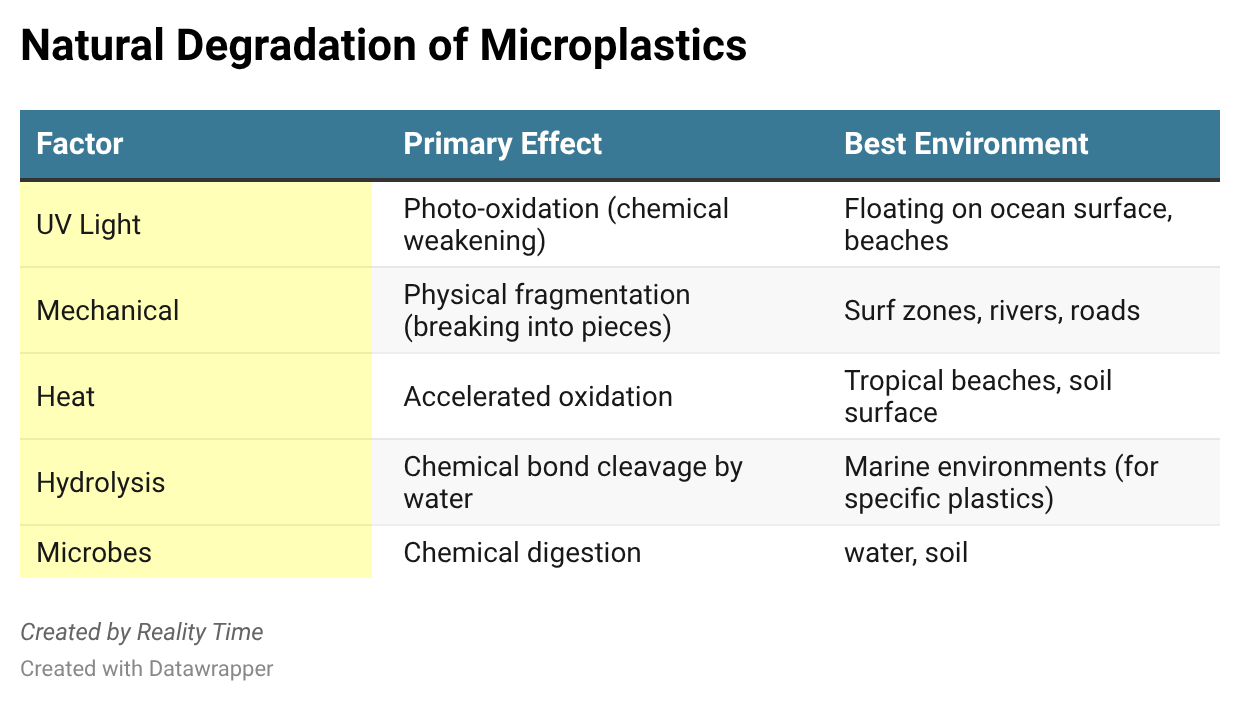
As mentioned above, the particles naturally decompose and break into smaller and smaller particles. The actual mechanism and speed of this process depend on the plastic.
To give some insight into this, consider a fresh salad sold in a plastic clamshell. It sits there for a few days before you eat it, but by that time, pieces of plastic have broken off the packaging and are eaten along with the salad.
Microplastics in the environment are naturally broken down in a variety of ways.
Plastisphere: A New Delicacy for the Microbes?
Microbes naturally degrade plastic, but there is a significant catch. While many natural microbes (bacteria and fungi) have been discovered that can “eat” microplastics, they usually do so at a pace that is far too slow to keep up with global pollution.
In the natural environment, these microbes often form a “biofilm” on the plastic surface, creating a living layer known as the Plastisphere.
Researchers have identified over 800 microbial species—roughly half bacteria and half fungi—capable of breaking down synthetic polymers.
Microbes excrete digestive enzymes that break down plastic into small carbon-based molecules, which are then absorbed and used as an energy source. The carbon is eventually excreted as CO2.
This sounds great, but there are two major hurdles.
The Speed Problem: In the wild, it can take decades or even centuries for natural microbes to fully degrade a single piece of microplastic.
The Trojan Horse: The “Plastisphere” can actually be dangerous. These microbial layers often attract pathogens and antibiotic-resistant bacteria, essentially turning microplastics into floating rafts that transport diseases across the ocean.
Bacteria, fungi, and algae can all biodegrade plastics. Even plants play a role. Microplastics can accumulate in the rhizosphere (area around roots), effectively removing them from water that is flowing through the soil. Plants can also absorb nonplastics and pass them to the upper tissues of the plant, which can be removed and processed.
In the last couple of years, scientists have started to bioengineer microbes to perform better.

Bioengineered Bacteria for Waste Treatment
Microplastics go right through wastewater treatment plants, so scientists are trying to develop engineered bacteria that degrade them right in the sewage treatment tanks.
Researchers from the University of Waterloo started with several species of bacteria that are naturally found in wastewater. They added special strands of DNA to them to make them more efficient at degrading polyethylene terephthalate (PET), a common plastic found in carpet, clothing, and containers for food and beverages.
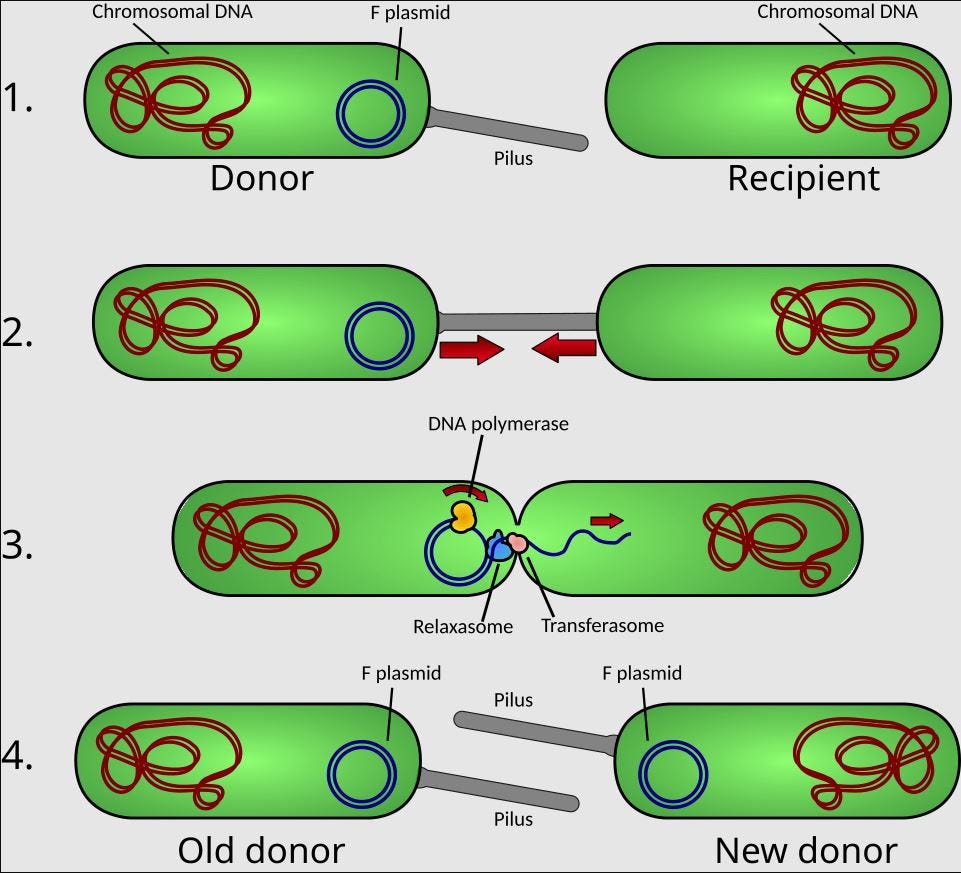
The research group is using a special property of bacteria called conjugation, which allows bacteria to share DNA with each other. In simple terms, a donor cell with the special DNA is able to connect to another bacterial cell and transfer a copy of the DNA to it. Once the recipient has it, it can use the DNA to make special proteins for digesting microplastics.
In theory, this allows you to add a small number of modified bacteria to a wastewater tank and have the special DNA transfer to many existing bacteria already in the water. It “amplifies” the power of the initial bacteria, making the process more efficient.
Although the initial concept work is promising, the technology needs more testing before it can be implemented.
The Technical Details:
Conjugation is often called “bacterial mating,” though it’s technically Horizontal Gene Transfer (HGT) because it doesn’t create a new organism—it just upgrades an existing one.
The process is remarkably mechanical:
The Approach (Pilus Formation): The Donor cell grows a long, hair-like tube called a sex pilus. It acts like a grappling hook, reaching out until it attaches to a Recipient cell.
The Contact: The pilus retracts, pulling the two bacteria physically close together until their cell membranes touch and form a controlled opening (a conjugation bridge).
The Transfer: The Donor doesn’t give away its only copy of the plasmid. Instead, it “unzips” the double-stranded DNA plasmid and sends one single strand through the bridge to the Recipient.
The Replication: Both cells now have a single strand. They immediately synthesize a matching strand to make the DNA double-stranded again.
The Transformation: The Recipient is now officially an Donor. It has the new genetic traits and the ability to pass them on to the next “neighbor.

Sticky Algae Collects Microplastics
Cyanobacteria, also known as blue-green algae, are common in freshwater. These microbes are able to photosynthesize sunlight to produce their own food. Although they are called algae, they are really bacteria.
Genetically engineered cyanobacteria have been produced that may help reduce microplastics in freshwater and sewage treatment plants.
Microplastic particles are so small that it is very difficult and expensive to filter them out of water. Special cyanobacteria may solve this problem.
The DNA of these organisms has been altered so that they produce a lot of limonene, which is the same compound that gives oranges their orange-citrus smell. It is also found in cannabis. Limonene is not very water-soluble and sticks to the outside of the cyanobacteria, making them very sticky.
Microplastics are hydrophobic and stick well to limonene. When you mix the cyanobacteria and microplastics in water, they aggregate into large clumps of sticky material. As the clumps get larger, they also get heavier and gravity pulls them to the bottom, where they settle as sediment.
That sediment can be harvested and filtered out of the water, producing clean water.
This process can be done in smaller reactors or in ponds and settling tanks, similar to those found in waste treatment plants.
Natural Microbes Are Adapting to Plastic
In 2016, scientists found a bacterium that was able to biodegrade PET using an enzyme now called PETase. Further testing has found bacteria that produce this enzyme in 80% of our oceans, including both surface water and depths of nearly two kilometers.
It is believed that the bacteria are evolving to make better use of their new food source - plastic garbage. This might be of particular importance for microbes found in deep waters, where a carbon source can be scarce.
Is Plastic Pollution Solved?
Not by a long shot.
Most of the genetically modified bacteria speed up the biodegradation process by 10%, but it is still a slow process. Microbes can also be difficult to manage in large-scale processing. Their enzymes may be easier to use.
A French company named Carbios is building a processing plant that will use engineered enzymes to recycle PET plastic, the dominant polymer in bottles, food packaging, and polyester textiles. Carbios has optimised the enzyme and the process to deconstruct all types of PET waste into its basic components, which can then be shipped to plastic manufacturers to make recycled PET and then new products. The plant is scheduled to open in 2016.
Soon, your T-shirts might be made from the water bottle you used.
The second to last line of the post cites 2016 as the opening date for the French plant. Typo?