
Should You Take Probiotic Supplements?
Don't believe everything you hear.

The frequently used term probiotics is widely seen as beneficial. We are regularly told that we need more probiotics. But is that really true? Are they really good for us? Do they work?
Should we take over-the-counter probiotic supplements?
What Are Probiotic Supplements?
Probiotics are microorganisms that are beneficial for our health. They are mostly bacterial but can also include yeasts.
Our bodies are covered with microbes, both on the outside and the inside, especially in our gut. Some of these microbes cause us problems, but most of them are not only beneficial, but some are essential to our well-being.
There are generally two ways in which we can add microbes into our body: through our food or with supplements in the form of powders, pills, and capsules.
A supplement is a manufactured product that contains one or more probiotics, and they are usually sold to do one of two things:
Add missing microbes to your gut.
Improve your health.
Regulatory Controls
In the United States, probiotics are regulated as dietary supplements under the Dietary Supplement Health and Education Act (DSHEA) of 1994. There is no pre-market approval. Claims of cures and preventions must be backed by evidence, but most companies get around this with special language that does not require proof of efficacy. Examples include “Supports digestive health,” “Promotes a healthy immune system,” or “Maintains gut balance.”
The Mandatory Disclaimer: Any product making a structure/function claim must include the famous box: “These statements have not been evaluated by the Food and Drug Administration. This product is not intended to diagnose, treat, cure, or prevent any disease.”
Information about the microbe species must be accurate, and the number of microbes (the CFU count) must be accurate at the time of manufacture.
In Canada, Health Canada must “pre-approve” the product before it can be sold. Each product is given an 8-digit Natural Product Number (NPN) indicating that the product has been approved for safety, quality, and health claims. Products that use pre-approved probiotic strains are quickly approved.
The regulations in the EU are quite different. While in the US, the word “probiotic” is a descriptive term for a category of ingredients, in the EU it is an implied health claim and is effectively banned from labels on food and supplements. For this reason, you rarely see probiotics for sale in Europe. When they are approved, they go through rigorous testing and approval similar to a drug.
The rest of this post will deal with over-the-counter probiotics supplements as defined in the US.

Claims for Probiotics
The claims are many. Here are some of the more common ones.
Supports Digestive Health
Promotes Immune System Function
Maintains Gut Flora Balance
Helps Reduce Occasional Bloating and Gas
Supports Vaginal and Urinary Tract Health
Promotes Regularity
Replenishes Beneficial Bacteria After Antibiotic Use
Supports the Gut-Brain Axis (Emotional Wellness)
Enhances Nutrient Absorption
Supports Skin Health from Within
The gut biome does a lot more than digest food. It affects our brain, our skin, and the body’s ability to fight infection, to name a few. Anything the gut biome can do is fair game for probiotic claims.
Microbes Are a Game of Numbers
The number of microbes in and around us is so huge that we can’t comprehend it. From my book Microbe Science for Gardeners: “Bacteria can’t be seen with the naked eye; 500,000 take up no more room than the period at the end of this sentence.”
The human gut is home to roughly 50 trillion microbial cells, a vast inner ecosystem that outnumbers our own human cells. One of the most common misconceptions is the sheer scale of the probiotic “army” being sent into the gut.
The Product: A high-quality probiotic supplement might contain 10 to 50 billion living bacteria.
The Gut: The adult colon contains approximately 50,000 billion living bacteria.
The number of bacteria you swallow is extremely tiny compared to what is already in your gut.
What is a CFU?
Colony-forming unit (CFU, cfu or Cfu) is a unit that estimates the number of living microbial cells (bacteria, fungi, viruses, etc.). Scientists measure this by spreading some of the material onto a petri dish, and if a cell is viable, it will grow to form a colony (a clump of cells). These colonies are then counted.
How Many Are in the Bottle?
The CFU value for each pill is found on product labels. It is important to remember that this is the number at the time of manufacture. However, the pill you take may not contain the specified amount. Microbes are living organisms and die over time, and will die more quickly if improperly stored.
You never know how many you are consuming. The main killers are the following.
Moisture: Probiotics are typically freeze-dried (lyophilized) to remove water. If moisture enters the bottle (from a humid bathroom or by leaving the lid off), the bacteria “rehydrate” prematurely. Without a food source to sustain them, they quickly burn through their energy reserves and die.
Temperature: High temperatures increase the metabolic rate of the bacteria. Even if they are dry, heat causes their cell membranes to become more fluid and unstable, leading to cell death. This is why many manufacturers recommend refrigeration.
Oxygen: Many probiotic strains (especially Bifidobacterium) are anaerobic, meaning they naturally live in environments without oxygen. Exposure to air can cause oxidative damage to their DNA and proteins, leading to a loss of viability.
Storage in a refrigerator has a CFU loss of about 15% a year, while storage in a warm, moist bathroom can have a 75% annual loss.
Do The Swallowed Probiotics Get to Your Gut?
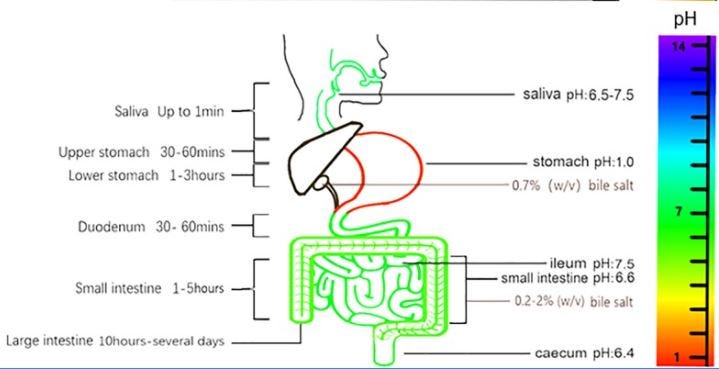
The journey from the mouth to the large colon (the “gut”) is essentially a biological gauntlet, and for a probiotic to be effective, it must survive the trip. The survival rate varies widely by strain (e.g., Lactobacillus vs. Bifidobacterium) and delivery method (pill vs. food). Here are the main obstacles.
The Mouth: Saliva contains lysozyme, an enzyme that breaks down bacterial cell walls. Pills pass through the mouth quickly with limited effect.
The Stomach: Gastric acid has a pH between 1.5 and 3.0, while most bacteria are evolved to live at a neutral pH (7.0). If the probiotic is taken on an empty stomach, the acid can wipe out nearly the entire population. However, taking it with a fat-containing meal can boost survival to 60% or higher.
The Small Intestine Environment: High concentrations of bile salts (which act like soap, dissolving the fatty membranes of bacteria) and digestive enzymes (protease, lipase) kill off more probiotics. Some probiotics are “bile-resistant”.
Competition: The small intestine contains active microbes that will compete with the probiotics for attachment sites and nutrients. Microbes also digest each other. The competition here is minor compared to what probiotics will face in the large intestine.
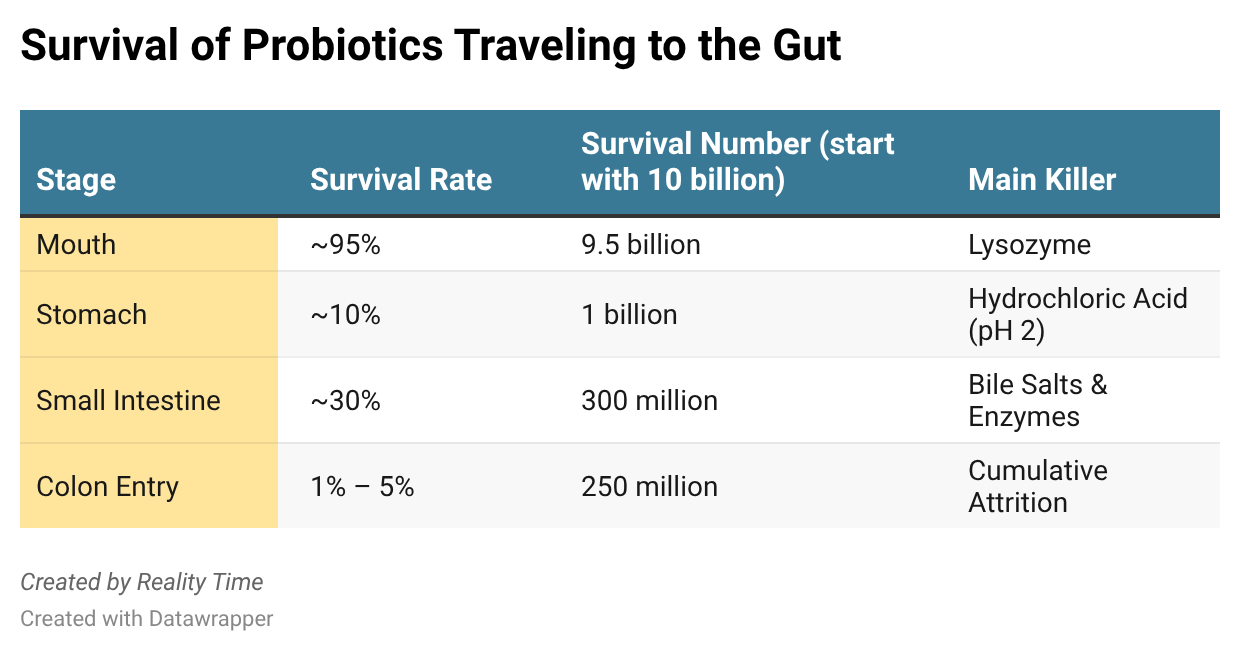
The above table calculates the survival number reaching the large intestine (the gut). A starting tablet of 10 billion CFU will result in about 250 million reaching the gut, ready to compete with the existing 50 trillion already there.
Increasing the Odds of Survival
Because the survival rate is so low, researchers and manufacturers use three main “cheats” to increase the number of bacteria to reach the gut:
Overdosing: This is why some pills have 50 billion CFU—they expect 48 billion of them to die.
Enteric Coating: A special “plastic-like” vegetable coating that doesn’t dissolve in acid but melts instantly when it hits the neutral pH of the small intestine. This can increase survival to 80%.
The Food Matrix: Eating probiotics in yogurt or kefir provides a “buffer.” The milk proteins and fats wrap around the bacteria, physically shielding them from the acid and bile.
Species Diversity
A healthy gut contains 500 to 1,000 different species, and because each species can have multiple strains, the number of unique strains in your gut is in the thousands. Compare that to supplements that contain 1 to 10 strains.
Clearly, a probiotic pill can’t supply all of your strains. The ones in the products are selected because they can be grown easily in a production facility.
When scientists look at the global human population, they have identified over 4,600 unique species. Everyone’s gut microbiome is different.
Species diversity is critical for a healthy gut. Adding a few new ones won’t make much of a difference.
Does the Microbiome Actually Change?
The most controversial aspect of probiotic science is whether these microbes actually “stick” or change our internal makeup.
A landmark 2018 study published in Cell by the Weizmann Institute of Science found that in many people, the gut is resistant to colonization. The probiotics passed through the digestive tract without altering the resident microbiome.
While probiotics may not permanently change the composition of your microbiome, they do change the metabolic activity (the chemicals the bacteria produce) while they are present.
Catch 22 - The Environment
Why take probiotics in the first place? They are taken mostly because we feel there is something wrong with our natural gut microbes. If that is true, then the environment in our gut is not suitable to keep them thriving. If the environment in our gut is not suitable for microbes, then adding a bunch more from a pill won’t change that.
The way you fix this problem is to change the diet. Once the environment is fixed, the natural gut microbes will thrive, and you don’t need to consume any from a pill.
We see the same situation in gardening. Companies sell bottled microbes to add to the soil. The claim is that this will increase the population in the soil. But that does not work because the environment - the soil - just can’t support a higher population. The solution is to add more organic matter to the soil. Do that, and the natural soil microbes population increases.
The secret for soil is organic matter. The secret for your gut is more real fiber, but not fiber supplements!
Evidence for Health Benefits
While they may not move in permanently, probiotic supplements have shown significant effectiveness in specific clinical scenarios:
Antibiotic-Associated Diarrhea (AAD): Antibiotics kill gut microbes. Taking probiotic supplements (specifically L. rhamnosus GG or S. boulardii) during a course of antibiotics can reduce the risk of diarrhea by up to 51%.
Irritable Bowel Syndrome (IBS): Meta-analyses suggest that probiotics can reduce bloating and abdominal pain in IBS patients, though the effect is modest and strain-dependent.
Mental Health (The Gut-Brain Axis): Emerging research into “psychobiotics” suggests that certain strains can lower cortisol and improve mood. A 2019 review found that probiotics could significantly improve symptoms of depression.
Many other claims for probiotic supplements have no or limited scientific support.
Conclusion: Are They Effective?
Probiotics are effective if used for the right reason with the right strain. They are not a “cure-all” that will fix your microbiome. Instead, think of them as temporary consultants for your gut—they come in, perform a specific job, and then leave.
Their ability to permanently change the gut microbiome of a healthy person is limited.
Many of the claims are not supported by science, and taking probiotics can disrupt a normal gut biome.
Should you Take Probiotic Supplements?
Many people take them to improve their overall health, but the science does not support this use. It is probably a waste of money.
They can be useful for specific medical problems, but only if the right strains are consumed in large enough quantities. For this reason, it is best to only use them under a doctor’s direction.
A better idea is to get your probiotics through food. A landmark 2021 study demonstrated that a diet high in fermented foods consistently increases gut microbial diversity.
Thank you for this. Once again you bring clarity and science to dispel commonly held myths. Though it has been many years since completing post graduate studies in Human nutrition and Nutritional pharmacology, I recall studies that support the use of both fermented foods and diet diversity as being key to obtaining and maintaining diversity and density of the microbial biome in the digestive tract.
I find it interesting how similar this is when compared to soils and the variety along with the density of microbes that can exist and thrive there, provided that there are a variety of plants growing within the soil, along with decomposition of organic matter. Those factors in turn provide nutrition and conditions that support a wide variety of microbes within root zones and surrounding soil.
Interesting stuff. Thanks Robert