
The Tongue Map Myth
Do different areas of our tongue really have different tastes? What is the difference between taste and flavor?

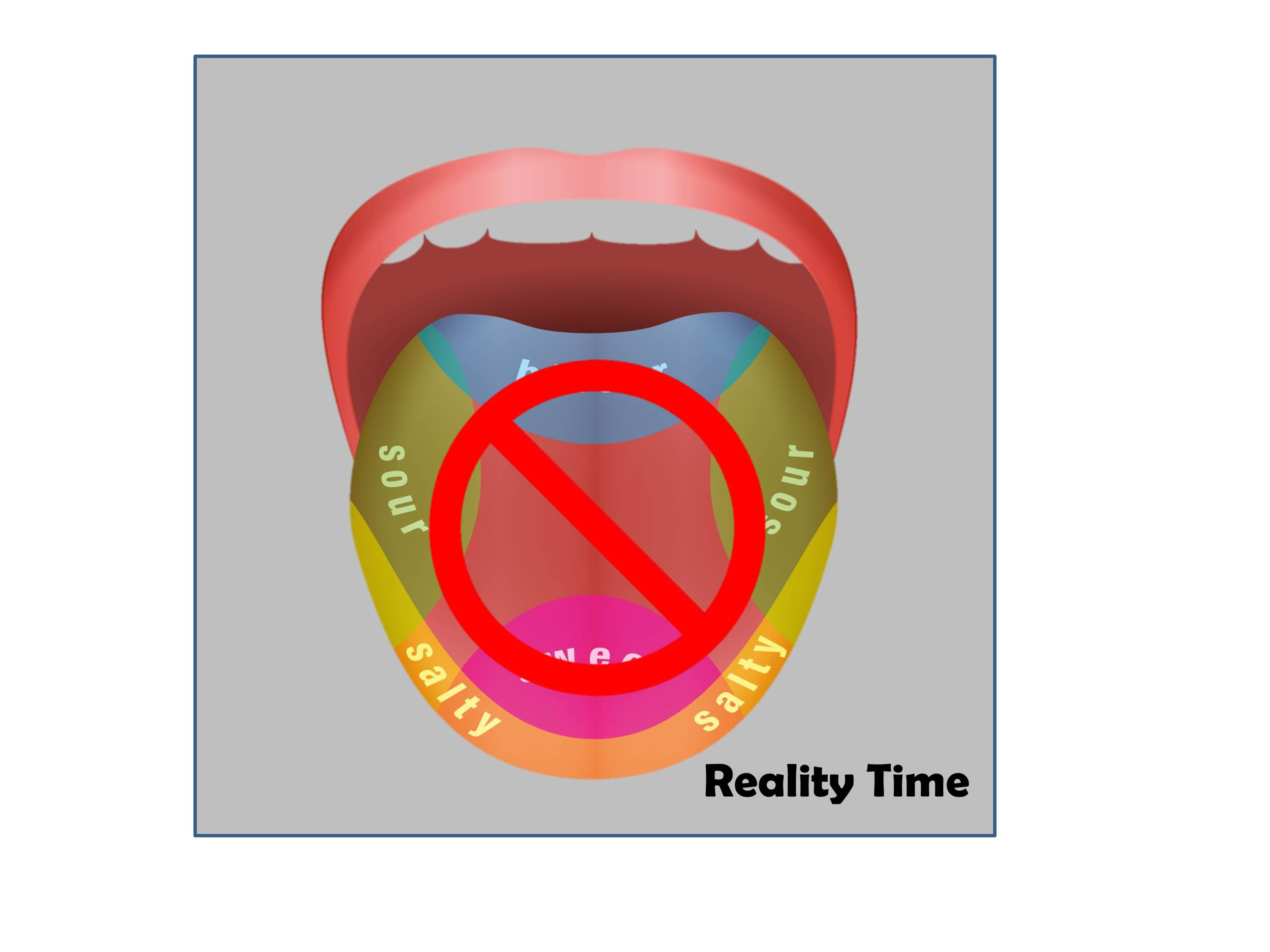
The traditional “tongue map” that shows specific, clearly delineated areas for tasting sweet, sour, salty, and bitter flavors is a myth.
While different parts of the tongue can be slightly more sensitive to certain tastes, all areas of the tongue and mouth that contain taste buds can detect all five basic tastes: sweet, sour, salty, bitter, and umami.
Origin of the Myth
The tongue map started with a German study in 1901 by D. P. Hanig that showed different areas of the tongue were minimally more sensitive to certain tastes. For example, the tip might detect sweetness at a slightly lower concentration than the back of the tongue. Hanig’s data showed differences in sensitivity thresholds, not exclusive zones.
In 1942, a Harvard psychologist named Edwin Boring published a paper on sensation and perception, in which he plotted Hanig’s data. The popular press took this work and incorrectly translated the subtle differences in sensitivity into distinct, non-overlapping regions—the “tongue map” was born.
Subsequent research, in the 1970s, confirmed that all taste buds are capable of detecting all five basic tastes. The tongue map is a myth that just won’t die.
The Experience of Taste
Taste buds are located throughout the mouth including the throat. The experience of taste is the result of signals from the entire mouth.
Scientists have now determined that a specific protein is responsible for tasting sour, which is really a measure of pH. The same receptors and proteins are also found in the spinal column where presumably it is used to monitor the pH of other body fluids.
Taste is a sensation that is caused when certain molecules attach themselves to taste receptors in the taste buds. The four common tastes are salty, sweet, sour, and bitter.
Sweet and salty are detected quickly, in less than a second, and therefore they can overpower the other tastes.
Bitter is detected more slowly, which explains why we describe some bitter food as having an aftertaste.
Umami (oo-MAA-mee) is a newly discovered fifth taste, which is described as savory and is evident in broths, cooked meats, and taco-flavored chips. Umami taste buds are responsible for sensing monosodium glutamate (MSG).
There’s considerable debate about the existence of a sixth taste receptor for fat, and some believe that we even have sensors for a soapy taste and a metallic taste.

We Don’t All Taste The Same Way
Did you ever burn your tongue by eating some hot food? That burning probably damaged your taste buds, resulting in food tasting bland. Don’t worry, taste buds are naturally regenerated every one to two weeks, so they will be replaced with new ones and your taste will be back to normal.
Babies and children have more taste buds than adults, which helps explain why they don’t like spicy food.
The number of taste buds we have also drops after we reach fifty. As we age, we also produce less saliva, and a drier mouth is less sensitive to taste. It is quite common for older people to lament about the good old days when food tasted better. The food has not changed, but our perception has.
Many people, called “supertasters,” are hypersensitive to bitter substances. Those who perceive little or no bitter taste are nontasters. This is all controlled by genetics, and was discovered by exposing people to a bitter chemical called 6-n-propylthiouracil. About 25 percent are supertasters, 28 percent are nontasters, and the remaining 47 percent are average. The reason for this difference is that the supertasters have a lot more taste buds. They are also more sensitive to other flavor sensations.
You might think that supertasters enjoy their food more than others, but unfortunately the sensitivity to bitter very often interferes with their enjoyment of salty and sweet tastes. This group of people tend to be picky eaters and dislike a lot of food. That seems to describe me quite well!
Taste vs Flavor
The terms taste and flavor tend to be interchanged but they mean very different things.
In general conversation, we use the word taste to reflect the sensation of food in our mouth, but strictly speaking, taste only refers to the sensation that food has on taste receptors.
Our experience with food is much more than just taste. Take mint, for example. It does have a taste, but it also has a strong aroma (a smell), and in our mouth it creates a cooling sensation as it stimulates certain nerve endings.
This overall sensation is known as the “flavor” of food and it includes the aroma, texture, and taste. Even the appearance of food affects our perception of flavor. The Flavor Extract Manufacturers Association (FEMA) describes flavor as “the entire range of sensations that we perceive when we eat a food or drink a beverage.” Flavor is largely subjective because everyone tastes and smells differently and their perceived understanding of the difference between a good and bad flavor varies a lot.
For example, I find the smell of celery very strong and hate the smell. For me there is a huge difference between tomato juice that has celery in it and one that does not. My wife can’t tell the difference.
We evaluate flavor first by a food’s appearance and color. Then we evaluate taste and aroma, and finally we experience texture. But it does not stop there; our bodies are also able to evaluate nutrition during and after digestion. We eat with our eyes. The size, shape, and color of food is what gets us to pick it up. Only then do we sense freshness, spiciness, sweetness, and all of the other sensations our mouth is capable of sensing.
Our senses do not determine flavor. We do have senses for taste, smell, sight, and touch, but flavor is created in our mind by combining all of the inputs from our senses. Flavor is in our mind, and that is one reason it is so subjective.