
What Is A Healthy CO2 Level?
Interesting facts about CO2 levels in our lives.

CO2 levels are increasing, and there is some concern that levels may be getting too high for humans. We also have special work situations like greenhouses where CO2 is added for improved plant growth, and submarines, which tend to have quite high levels of CO2. Are these places safe?
There is also the notion that CO2 is a poison, but is that really true? Is the real problem a reduction of oxygen or an increase in CO2?
What are Normal CO2 Levels?
I found the following meme online without a reference. The discussion that followed the post made it clear that people don’t understand the safe CO2 limits for human health.
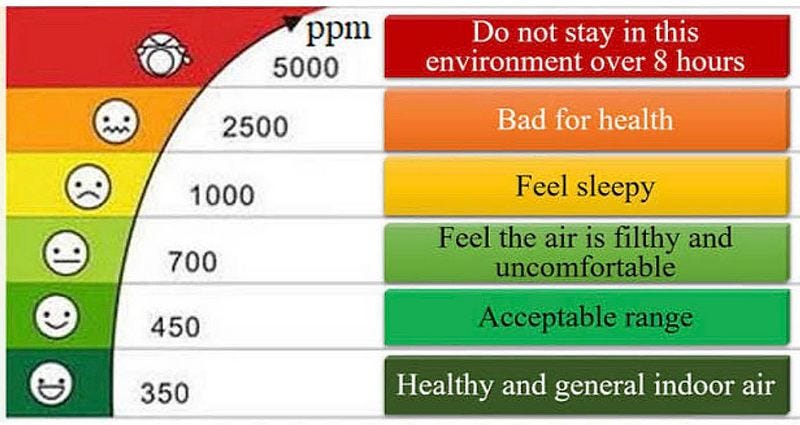
The meme is not correct. Note the 350 value, which is below the current outdoor level of about 430 ppm. Indoor levels can rise significantly.
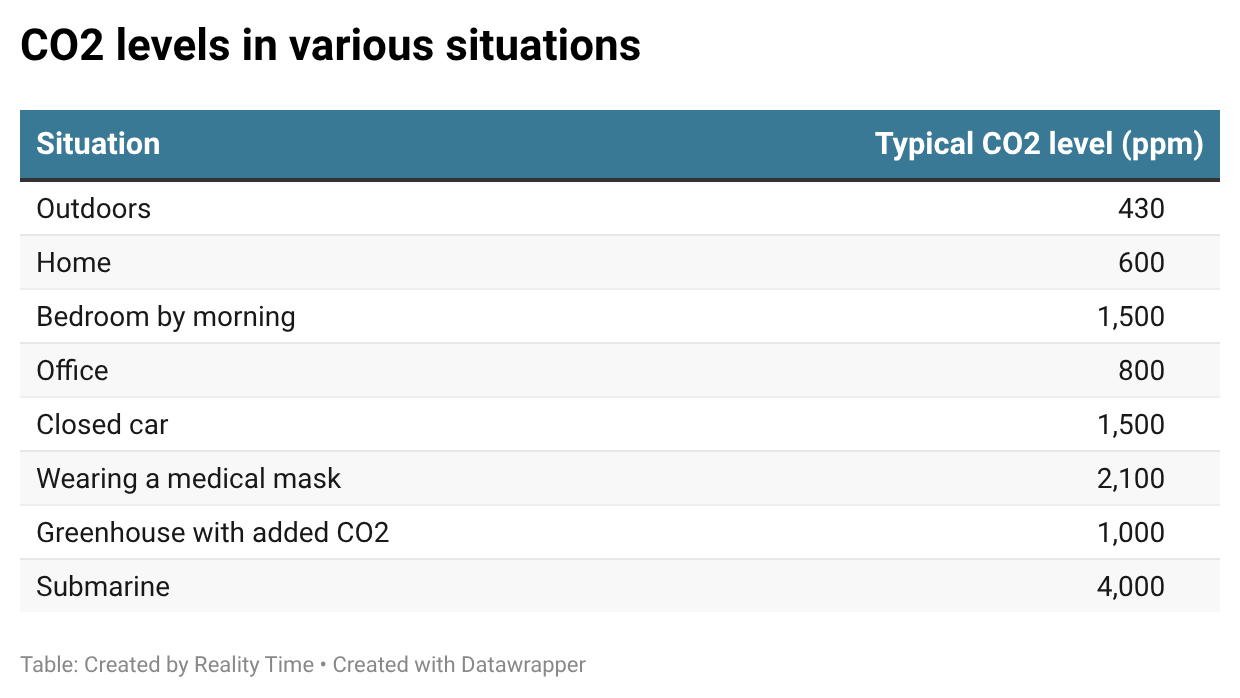
The following table provides the average CO2 level for a number of locations.

What Is A Safe CO2 Level?
One would think that this is an easy question to answer, but different situations have different safe levels assigned. Homes and workplaces have different values, and they are different again for a submarine.
In the context of human health, carbon dioxide (CO2) levels are categorized by their impact on comfort, cognitive performance, and physiological safety. While outdoor levels typically hover around 430 ppm, indoor levels can rise significantly depending on ventilation and occupancy.
Recent research has challenged the older assumption that CO2 is harmless at low concentrations.
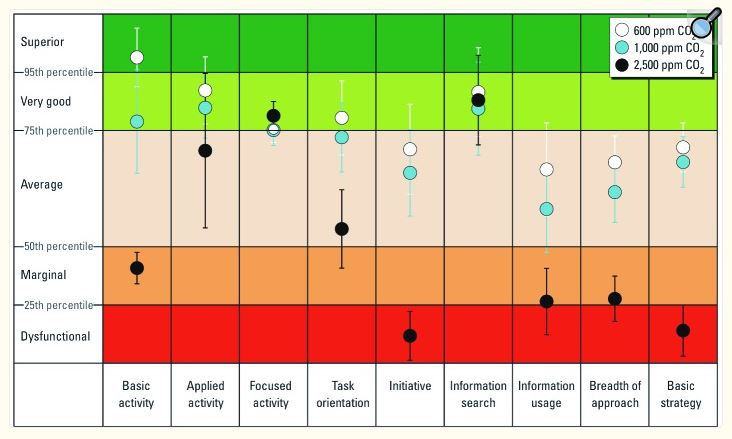
Cognitive Decline: Studies show that at 1,000 ppm, decision-making performance begins to decrease. At 2,500 ppm, some cognitive test scores can drop by as much as 50%.
Physiological Stress: Elevated CO2 can lead to “respiratory acidosis,” where the blood becomes slightly more acidic, potentially affecting the human proteome and metabolic functions.
Sick Building Syndrome (SBS): Levels above 700–800 ppm are frequently associated with symptoms such as eye irritation, rhinitis, and fatigue.
A study looking at cognitive abilities at different CO2 levels (600, 1,000, and 2,500 ppm) found that at both higher levels there was a statistically significant decrease in six of nine scales of decision-making performance.
Health Symptoms - 1,000 to 2,000 ppm
Starting at 1,000 ppm, CO2 begins to cause noticeable symptoms as oxygen in the air is displaced by CO2 molecules. The following are common.
drowsiness
feeling of stuffiness
mild confusion
disorientation
Health Symptoms - 2,000 to 5,000 ppm
Beyond 2,000 ppm, CO2 can cause disruptive health and cognitive symptoms, including:
headaches
feeling sleepy
tightness in the chest
increase in heart rate
reduced attention
lack of concentration
nausea
Safe CO2 Level For The Home
Health Canada recommends a long-term exposure limit of 1,000 ppm based on a 24-hour average to prevent symptoms like headaches and tiredness.
ASHRAE (American Society of Heating, Refrigerating, and Air-Conditioning Engineers) suggests maintaining levels no higher than 1,100 ppm (700 ppm above the local outdoor concentration) to ensure adequate ventilation for occupant comfort.
Normal activity will keep CO2 levels below the 1,000 ppm value. However, sleeping in a closed room can easily exceed this during the night. Without adequate ventilation, concentrations can climb to 2,000–3,000 ppm by early morning.
Safe CO2 Level For The Workplace
Workplace standards are often much higher than home standards because they focus on preventing acute physical harm rather than maximizing comfort.
OSHA: Permissible Exposure Limit (PEL) is 5,000 ppm for an 8-hour workday.
NIOSH: Set a Short-Term Exposure Limit (STEL) of 30,000 ppm for 15 minutes.
IDLH: A concentration of 40,000 ppm is considered “Immediately Dangerous to Life or Health.”
CO2 Level In A Greenhouse
CO2 is commonly injected into commercial greenhouses. Higher CO2 results in more photosynthesis and faster plant growth.
Target Range: 800 – 1,200 ppm is the industry standard.
The “Sweet Spot”: 1,000 ppm is considered the most cost-effective level. At this concentration, most plants see a 20–50% increase in growth rate and yield.
Maximum Enrichment: 1,500 ppm is generally the upper limit for benefit. This is well below the safety ranges for workplaces. Many greenhouses install safety alarms set to trigger at 2,000 or 3,000 ppm to ensure a malfunction doesn’t create a pocket of high-concentration gas.
CO2 does make plants grow better, but there is a limit. Plants will be damaged above 2,000 ppm. The “stomata” (pores on the leaves) close too tightly, preventing the plant from “sweating” (transpiration), which leads to leaf burn, necrosis, and stunted growth.
CO2 Level In A Submarine
On a submarine, carbon dioxide levels are significantly higher than those found in other workplaces or homes. Because submarines are closed systems, keeping CO2 at outdoor levels is technologically impractical, so the Navy operates under much more permissive standards.
The average range is 3,500 to 4,100 ppm with an upper range capped at 5,000 ppm. However, they can go as high as 10,000 ppm for short durations. Emergencies can see values go as high as 25,000 for short periods.
CO2 Concentration Of Inhaled Air
The CO2 concentration in our exhaled breath is between 40,000 and 50,000 ppm. This air dissipates within 1 to 3 seconds. Our next breath receives CO2 levels of about 430 ppm if you are outside. It will be higher indoors depending on air movement around your body and the current level in the room.
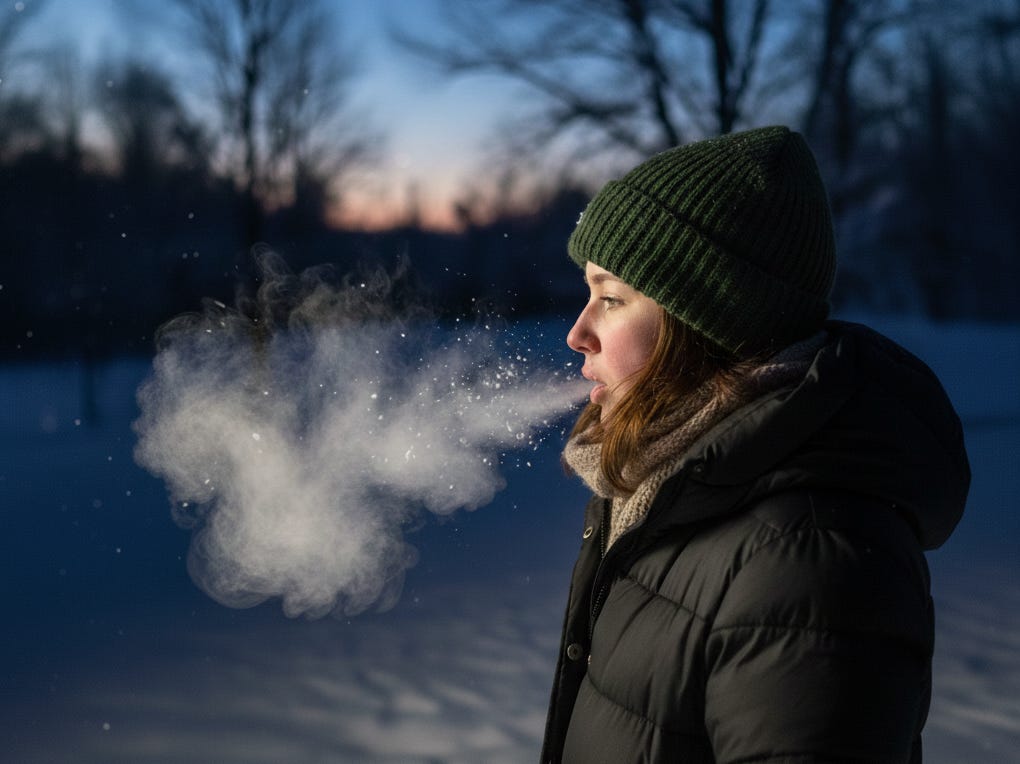
You can easily see how fast your breath dissipates if you live in a cold climate. Breathe out in cold air, and the water vapor will condense into a “white smoke”. It quickly leaves the area immediately around your mouth, even in a very mild wind.
You also rebreathe some of your exhaled air because some of it gets stuck in the trachea and nasal passages. This “dead space” air is still at ~40,000 ppm. When you take your next breath, that is the first air to enter your lungs.
In a typical indoor setting with no active breeze, the air right next to your nose can be 3 to 10 times more concentrated than the room’s average until it dissipates or is moved by a fan.
What happens under the covers while you sleep? Your next breath could have levels between 5,000 and 20,000 ppm. This is why you might wake up with a “CO2 headache” if you sleep with your head under the covers—you are effectively “recycling” your own exhaust.
CO2 Level Wearing A Mask
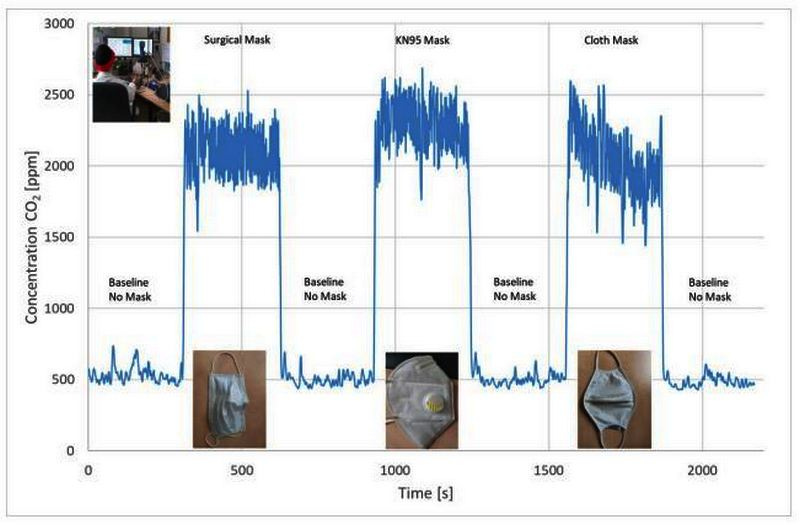
Wearing a medical mask is much like lying under a heavy blanket in bed - the CO2 levels build up. The following shows that wearing a mask can increase levels from 1,500 to 2,500 ppm CO2. Other studies have found higher values (3,000 - 5,000 ppm).
CO2 Changes Over Time
Humans have caused the natural CO2 level in the air to increase faster than it would naturally. The following chart plots this change since 1775 (279 ppm) and compares it to our exposure in various situations.
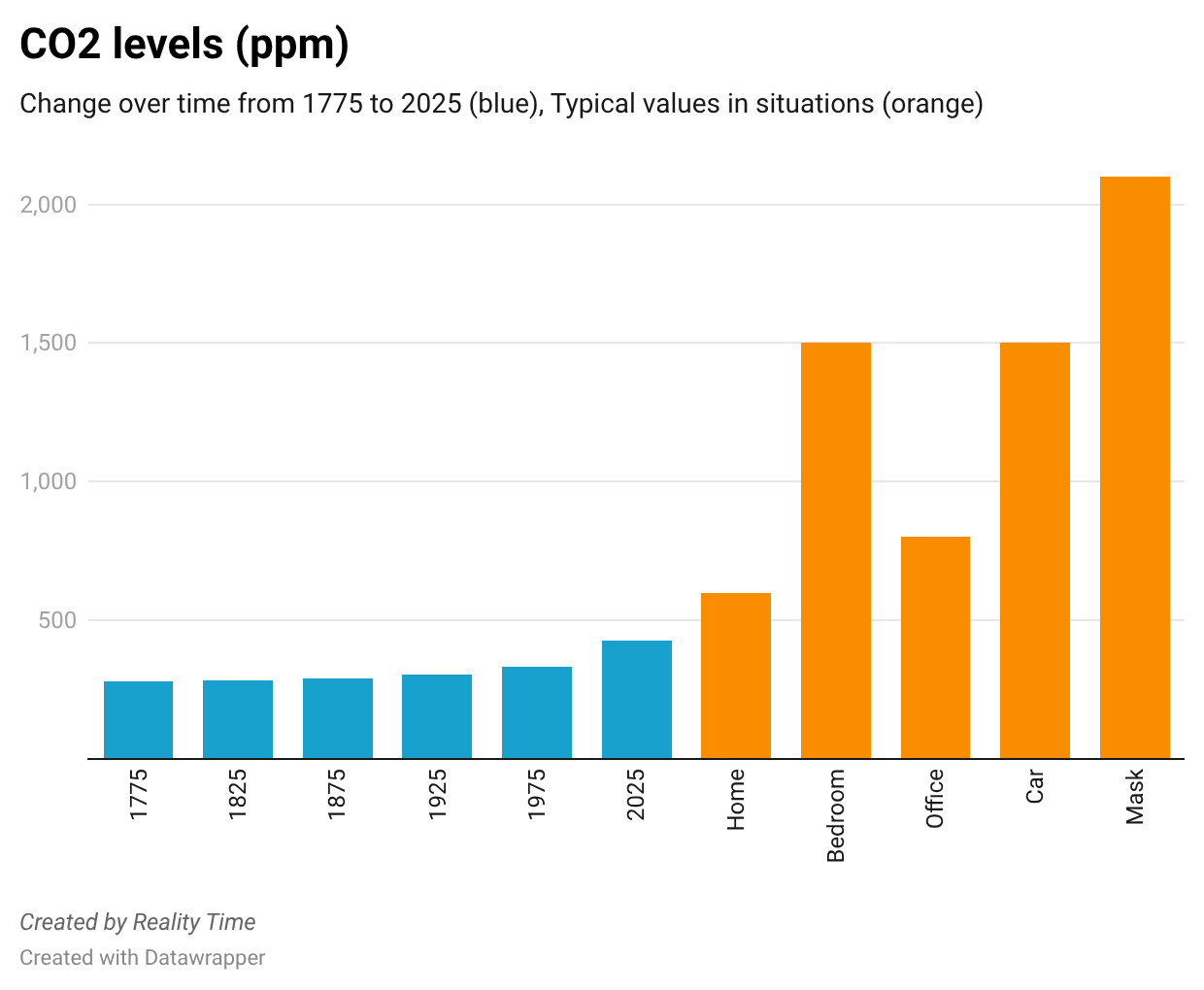
The rate of historical increases is significant when compared to the natural rate of increase. However, they are not significant compared to the daily fluctuations humans are exposed to.
CO2 Health Myths
There are several common myths about CO2 and our health.
Myth #1: It’s Not CO2, But A Lack of Oxygen
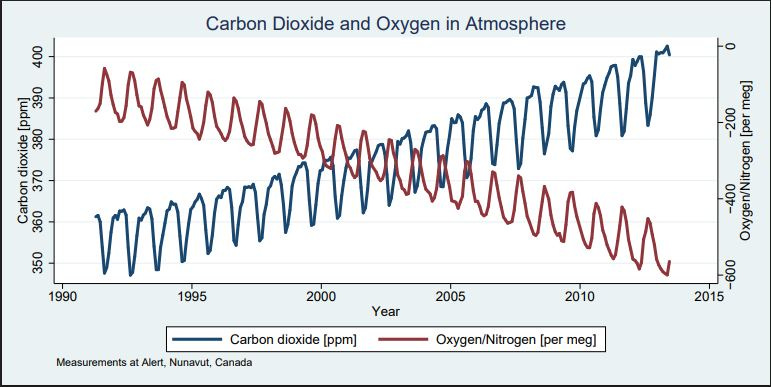
As CO2 levels in the air rise, the oxygen level drops. This has led people to suggest that the main problem for humans is a drop in O2 levels, not the increase in CO2. The main reason for this claim is that CO2 is “not toxic”.
The level of oxygen in the air is about 210,000 ppm. Safe oxygen levels for humans, as defined by OSHA and industry standards, range between 195,000 (19.5%) and 235,000 ppm (23.5%). Levels below this cause impaired judgment and breathing issues, while levels above this range are highly combustible.
If CO2 levels were to increase by 5,000 ppm to 5,430 ppm, the oxygen level would be 204,530, which is well within the safe range.
For oxygen to reach the low safety limit of 195,000 ppm, CO2 levels would need to reach 15,000 ppm.
These numbers show that you will start feeling the negative effects of high CO2 long before you feel the effects of low oxygen. These numbers assume that the CO2 is added by converting oxygen into CO2 in a closed space.
Myth #2: CO2 Is Not Toxic
The USDA Food Safety and Inspection Agency disagrees and says, “CO2 is considered to be minimally toxic by inhalation.”