
Are Polar Bears Going Extinct?
No ice - No polar bears - Not True!

Climate change is melting sea ice, and polar bears depend on that ice to help them catch seals, their main food source. A loss of sea ice means starvation and possible extinction for the bears.
The claim that polar bears are going extinct has been around for a number of years, and it simply is not true, at least not in the near term.
Are Polar Bear Numbers Declining?
The answer is a bit complicated, so I’ll provide the short answer in this section, and then explore some of the data and the complications in the rest of the article.
Polar bears live in the Arctic in 20 subgroups. We only have population data for some of these groups, and even then, the data is not very precise.
The data we have shows that the population is stable or even increasing. Some subpopulations are increasing, while others may be decreasing. The warming trend over the past 50 years has not affected the population very much.
The current population is between 26,000 and 32,000.
There is also some preliminary data to suggest that polar bears can adapt to the loss of some sea ice.
Claims of extinction by climate alarmists are certainly not true.
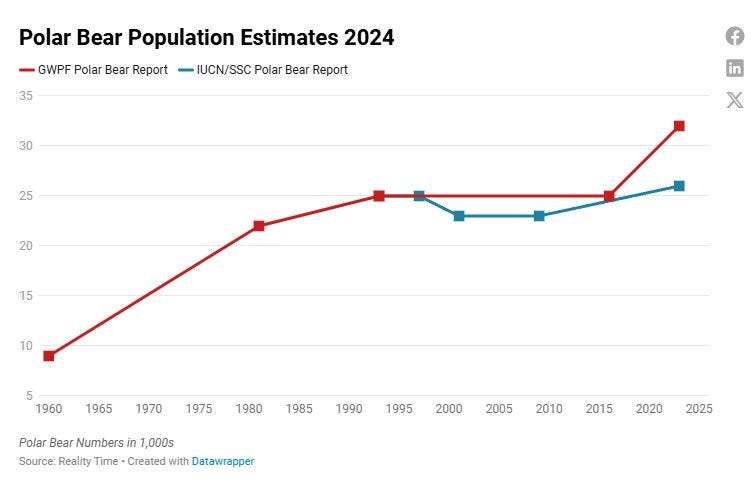
The above graph uses the data from two reports: GWPF Polar Bear Report 2023 by Susan Crockford and IUCN/SSC Polar Bear Specialist Group Report, 2024, both of which are discussed in more detail below.
The latest (2024) official total population estimate in the IUCN/SSC report is 26,000 (range 22,000–31,000), which was determined in 2015 and has not been adjusted since then. Their estimate has not been updated to account for statistically significant increases in two subpopulations and the addition of a newly-discovered subpopulation (Kane Basin is up by 133, Southern Hudson Bay is up by 223, and newly-discovered SE Greenland adds another 234). The new adjusted estimate would be 26,600.
There is little population data for some subpopulations.
The large jump in numbers from 1960 to 1995 can be explained by international actions to reduce hunting to save a rapidly declining population in the 1950s. The 1973 Agreement on the Conservation of Polar Bears was signed by the five Arctic nations (Canada, Denmark/Greenland, Norway, USSR, and USA), which went into force in 1976.
The numbers for 1960 are mostly a guess, based on limited data.
The Reality: Contrary to claims by climate alarmists, polar bear populations are not declining.

The Problem With Polar Bear Data
Polar bears cover a very large amount of territory that has few inhabitants. There is no easy way to determine accurate numbers for the population. Much of the data is based on models that estimate the populations.
Here is how researchers actually get those numbers:
Aerial Surveys (Distance Sampling)
This is currently the most common method for large-scale counts. Researchers fly small planes or helicopters along “transects” (straight-line paths) across the sea ice or coastline.
They don’t just count what they see; they use Distance Sampling. By measuring how far a bear is from the flight line, they can statistically calculate how many bears they likely missed.
Some surveys now use infrared cameras to detect the heat signatures of bears against the cold ice, which is much more effective than relying on human eyes alone.
Genetic Mark-Recapture (The “Non-Invasive” Way)
In the past, scientists had to physically tranquilize and tag bears. Today, they often use “genetic tagging.”
Scientists in helicopters use low-impact darts to take a tiny skin sample (about the size of a pencil eraser).
On land, “scented” stations with barbed wire snag tufts of fur as bears pass by.
By identifying the unique DNA of each bear, researchers can see how many “new” bears they find versus “recaptured” bears (ones they’ve sampled before). The ratio allows them to estimate the total population size.
Satellite Telemetry
While not a direct counting tool, GPS collars are essential for defining where to count.
Only female polar bears can wear collars. Males have necks thicker than their heads, so the collars just slide right off!
By tracking movements, scientists can define subpopulation boundaries. If we didn’t know where one group ended and another began, we might count the same bear twice in different surveys.
Indigenous Knowledge (IK)
In regions like Northern Canada and Greenland, researchers rely heavily on Indigenous Knowledge. Local hunters and community members observe bear movements and health year-round, providing “on-the-ground” data that a two-week scientific survey might miss. There is currently limited use of this information.
Is Climate Change Real?
If you are like me, you believed all of the headlines. Global warming is mostly caused by humans burning fossil fuels. This heating phenomenon is causing huge changes in the climate. Ice caps are melting, reefs are bleaching and dying, the sea level is rising, the intensity of storms is worse, there are more forest fires, etc.
GWPF Polar Bear Report 2023
The State of The Polar Bear Report 2023 is produced by the Global Warming Policy Foundation and written by Susan Crockford. Susan has studied polar bears and has written a couple of books, Polar Bear Evolution and The Polar Bear Catastrophe That Never Happened.
This report concludes the following.
There were no reports from the Arctic in 2023 indicating polar bears were being harmed due to a lack of suitable habitat, in part because Arctic sea ice in summer has not declined since 2007 (more on this below).
A survey of Southern Hudson Bay polar bears in 2021 showed an astonishing 30% increase over five years, which adds another 223 bears to the global total.
A concurrent survey of Western Hudson Bay polar bears in 2021 showed that numbers had not declined since 2004.
Historically, there have been 19 subpopulations established in the 1970s. A new subpopulation was discovered in Greenland, bringing the total to 20.
The following shows the current number of bears in each subpopulation.
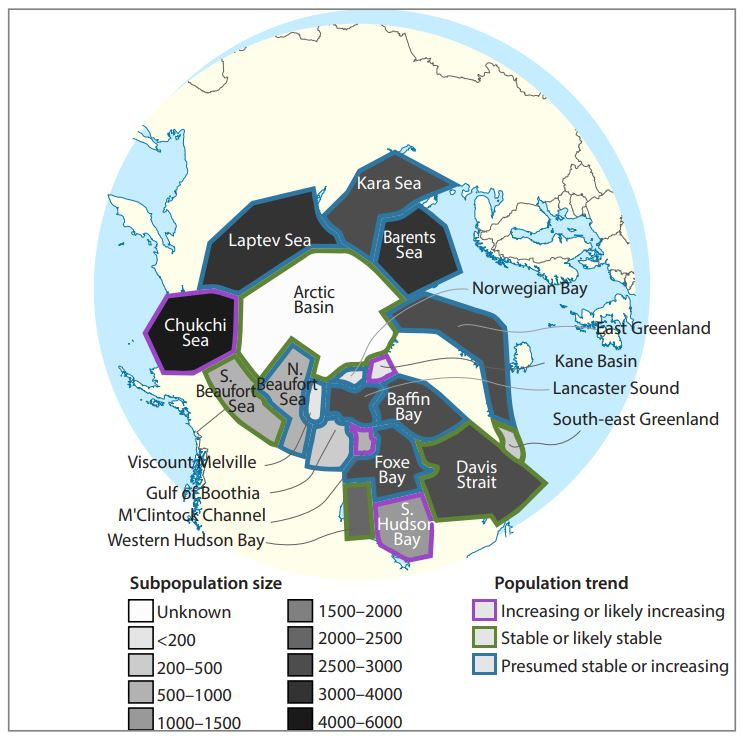
The study concludes that “the data provided to date indicate that polar bears are currently thriving and probably slowly increasing in abundance despite an almost 50% decline in summer sea ice extent since 1979.
Note the population trend. They report that all populations are either stable, increasing, or likely to be increasing. That is a more positive outlook than the next report.
IUCN/SSC Polar Bear Specialist Group Report
This report, dated October 2024, is produced in cooperation between the IUCN (International Union for Conservation of Nature) and SSC (Species Survival Commission).
The complexity of counting polar bears is verified in the report. This quote will provide some insight into this issue:
“Studying polar bears is expensive and logistically difficult (Vongraven et al. 2012), and subpopulations differ in how much information is available to understand their statuses and trends. There is high uncertainty about the discreteness and status of several subpopulations, particularly in the Russian Arctic. For example, until 2005, the PBSG Status Table included estimates for three subpopulations (Chukchi Sea, Kara Sea, and Laptev Sea) where accepted scientific methods had not been applied. These estimates were removed in 2005 to avoid the incorrect impression that reliable data were available. Similarly, the PBSG has never provided estimates of abundance for the East Greenland and Arctic Basin subpopulations.”
It should be noted that this report did not include data for the new East Greenland subpopulation, even though estimated numbers exist between 200 and 300.
How many polar bears are there based on this 2024 report? That is not really clear. The report says “The most recent estimate of global abundance is 26,000 (95% Confidence Interval [CI] = 22,000–31,000; Regehr et al. 2016)”, but that number is based on a study containing 2015 data, published in 2016.
I contacted the group and asked them why the data is not more current. Kristin L. Laidre, one of the contributing authors of the report replied with the following:
“That paper is based on the most recent RedList assessment conducted by the PBSG. That assessment is currently being updated (in progress) and the new assessment will use all available updated data. RedList assessments are roughly updated every decade. There have been changes in abundance for some polar bear subpopulations (also shown in our Status Table), but those changes are variable and not at the magnitude where I would expect the global estimate to change very much.”
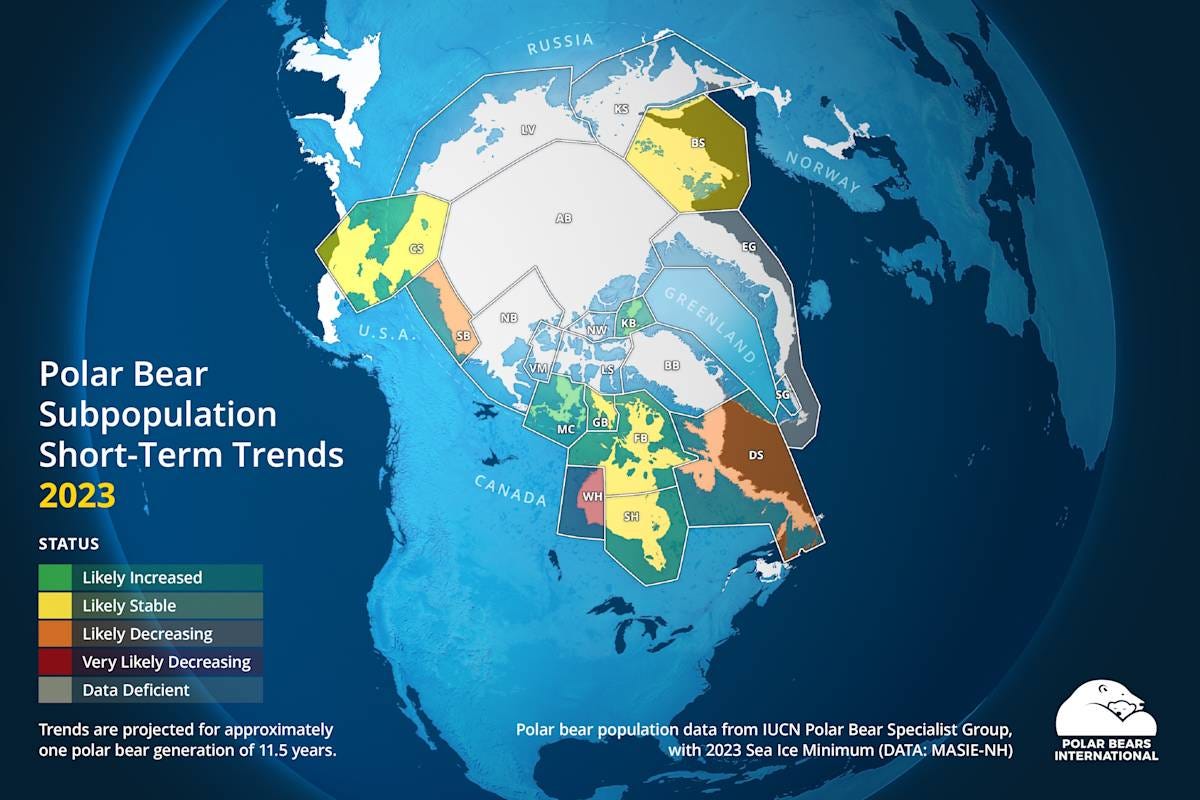
Their claim of population status is not as positive as the previous report. A few may be declining, and data is missing on quite a few populations. Their total population data shows a slight upward trend.
Does Climate Change Increase The Number of Deaths Due to Temperature Extremes?

In my climate change post, I commented that “global warming is reducing the number of deaths due to temperature extremes. Several people disagreed with me and pointed to comments like this one from the WHO (World Health Organization):
Hudson Bay Polar Bears
A popular comment online is that the Hudson Bay polar bear population is declining, mostly because the sea ice in the Hudson Bay is decreasing fast.
Some scientists suggest that the decline of the Western Hudson Bay population may be due to the migration of animals into the Southern Hudson Bay region, which has seen an increase in population. Susan Crockford says, “The possibility that during 2017–2021, hundreds of bears may have been moving undetected between all Hudson Bay subpopulation boundaries, including Foxe Basin (FB) to the north, has broad implications.”
Others claim that it is only the males that have migrated.
Changes in the environment may result in a shift of populations, and it may be time to reevaluate subpopulation boundaries.
In reading the reports, it is clear that there is no agreement between scientists on the Hudson Bay population or about changes in boundaries. The Hudson Bay population may not be declining, just moving around more.
The Role of Sea Ice
To understand the fate of polar bears, it is important to understand the relationship between them and sea ice as well as the effect global warming has on sea ice.
In some respects, polar bears are more like marine mammals than bears because their entire life cycle is tethered to the frozen ocean. They are specialized predators of ringed and bearded seals, but they are not fast enough to catch seals in open water. They wait until the seals are resting on a sea ice platform and then ambush them.
Generally, polar bears will starve if there are more than 100 sea-ice-free days during the year.
Polar bears are capable of swimming long distances, but it is incredibly energy-intensive. They are better at running and walking. Sea ice allows them to travel thousands of miles to follow prey or find better habitat with minimal effort.
The Hudson Bay is a good example of the relationship between ice and bears. The Hudson Bay has seasonal ice and undergoes a complete melt every year, forcing bears into a unique migratory rhythm.
In a typical year, Hudson Bay is fully frozen by late December and completely ice-free by August. When ice concentration drops below 30–50%, it becomes too unstable to hunt seals, and bears return to solid ground (June/July).
Once on land, they start to fast, living off their fat reserve. When ice forms again (October/November), they use it to hunt seals.
A warming climate results in a longer period of time when the bay is ice-free, which means the bears have to fast longer. If the fasting period gets too long, they will not survive. This is why the Hudson Bay subpopulation is particularly vulnerable.
Seals feed on smaller animals like crabs, shrimp, krill, and amphipods (all crustaceans), which in turn feed on phytoplankton. The phytoplankton requires sunlight and grows best where the ice is thin enough to allow sunlight to get through.
More northern regions of the Arctic have a thick ice covering all year long, which prevents phytoplankton from growing. That, in turn, keeps seal and bear populations low. As the Earth warms, these regions are seeing more thin ice, which results in more phytoplankton, more seals, and more bears. This may explain why some polar bear populations are increasing in number.
The Importance of the New Greenland Population
This new population has very little sea ice and has learned to survive on glacial ice found on land. This may indicate that other populations can also do the same. Or perhaps the Greenland population can be introduced in other areas as sea ice disappears.
How is Arctic Sea Ice Changing?
The following chart is a regularly seen chart showing the change in sea ice extent over the years. The trendline appears to show a decline of about 10% per decade, leading one to predict the ice will soon be gone.
In 2021 the IPCC wrote: “The September Arctic Sea ice is projected (by CMIP6 model simulations) to be practically ice-free near mid-century under mid and high GHG (greenhouse gas) emissions scenarios.”
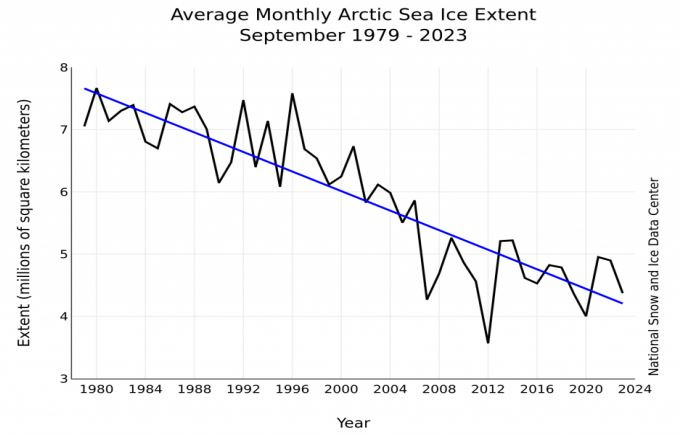
Ice values for September are of most interest because it is the time of year with the least amount of ice.
Allan Astrup Jensen had a closer look at this data and reported his findings in a paper called “Time Trend of the Arctic Sea Ice Extent Since 2007”. Here is a slightly different plot using data from the same source.
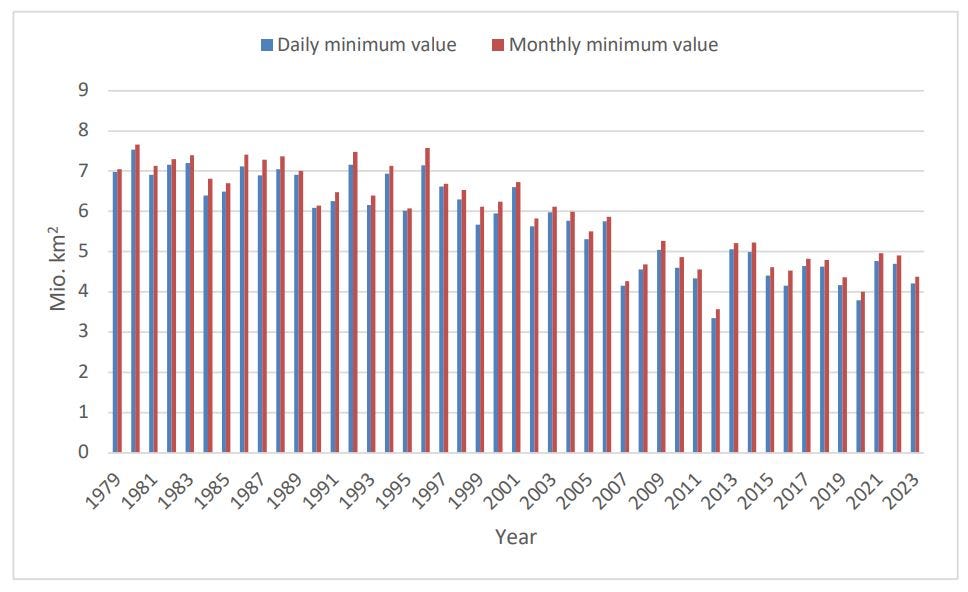
The downward trend is not as obvious in this plot. There is a plateau from 1979 to 1996 and another one from 2007 to 2023. There is a sharp decline between these periods. These plateaus are also visible in the previous figure if the trend line is removed.
This plateau is even more obvious if we plot the latest 17 years.
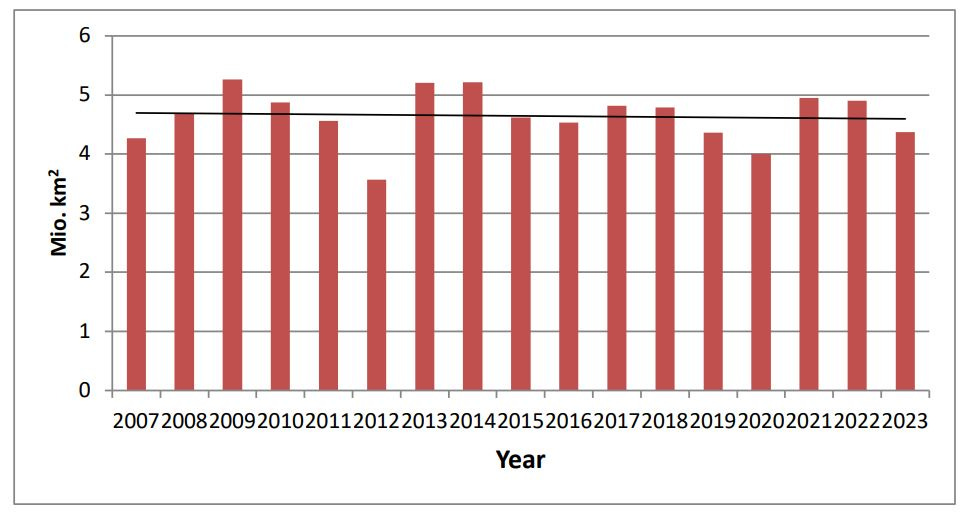
Scientists acknowledge that the sea ice has not decreased over the last 17 years. The data for 2025 is in, and the sea ice value is higher than in 2023 and 2024, with no sign of a downward trend.
The long term trend for sea ice is certainly down, but it is not decreasing as fast as many climate alarmists claimed, and it is not decreasing as fast as climate models predicted. Right now, it is actually steady, which is good news for the polar bears.
Conclusions
The claim that polar bears will soon be extinct is completely false. Claims that their population is decreasing are not supported by the data.
Polar bear numbers are stable and may actually be increasing slightly. However, it has to be remembered that the accuracy of our population data is limited. All reported numbers are estimates with significant variability.
Sea ice is decreasing over time, but it has been stable since 2007. The current trend will have a limited effect on polar bears.
There is evidence that polar bears will migrate, which may help them survive any future loss of ice. There is also evidence that they will change their eating habits. Global warming will impact them, but they seem to be more resilient than we initially thought.
Good news on Polar Bears:
https://www.nature.com/articles/s41598-025-33227-9
From Nice News: Polar bears play a uniquely crucial role in the Arctic ecosystem — and thankfully, one population in particular may be in better physical health than 25 years ago. A new study suggests that despite sea ice losses caused by climate change around the Norwegian island of Svalbard, the mammals’ fat reserves have increased.…the recent findings have defied Aars’ expectations, a hopeful sign for the polar bears’ future. “When I started, if you asked me what do you think will happen, I would assume they would be struggling and they would get leaner, skinnier, and maybe you would see effects on reproduction and survival,” he said. “That was wrong.”
Now read this article:
https://polarbearsinternational.org/news-media/articles/are-polar-bear-populations-increasing
It's stronger than Robert’s because it focuses on habitat and long-term ecological limits, not just raw population numbers, and places those numbers in context through expert interpretation rather than relying on solo data reading. The piece at Polar Bears International clearly explains that there are 20 polar bear populations with very different trends, that the global average is not increasing, and that long-term habitat declines from sea-ice loss are the real risk—a view grounded in expert science from active researchers and conservationists.
Robert, you spent all this time writing this article, but you couldn’t speak directly to even ONE polar bear scientist to better understand a complex dataset???